The Origins of Emoji
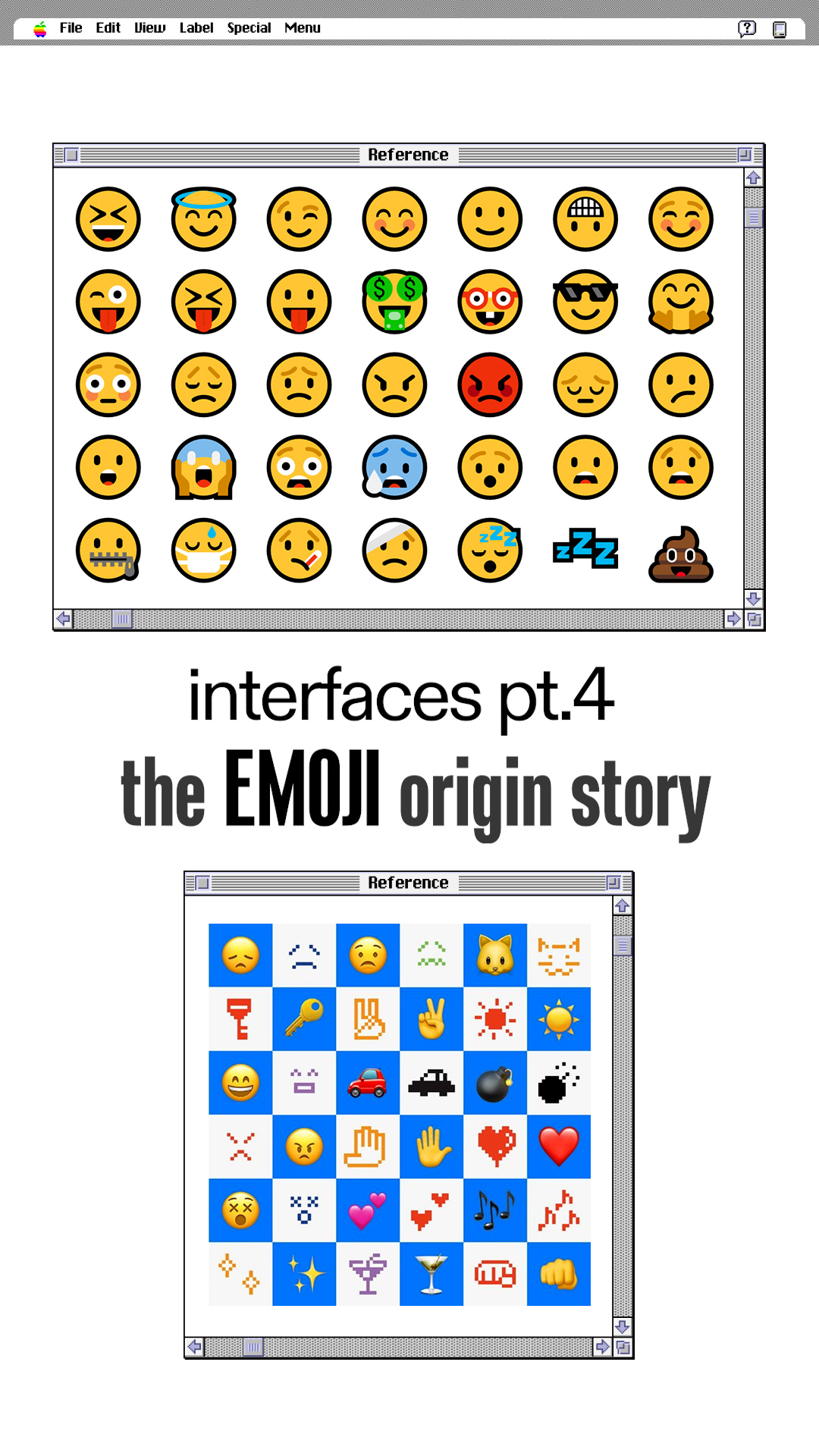
Transcript
Emojis. Love ‘em or hate ‘em, they’ve been part of our digital lives for a long time.
Here’s how they were born.
It’s 1999. Shigetaka Kurita is a young designer at NTT Docomo in Japan, on the team building i-mode.
From its founding in 1991 by the Japanese national carrier Nippon Telegraph and Telephone, NTT DOCOMO was at the forefront of the burgeoning field of mobile communications.
They had a really successful pager called the Pocket Bell, which displayed the first emoji—a heart. When they started to make the push into a truly mobile internet—a software platform called i-mode—they knew that they wanted a killer app.
Kurita was given the task: draw 176 pictures, each on a grid of 12 by 12 pixels.
He borrowed from everywhere. Public pictograms, like the cigarette from a No Smoking sign. Text emoticons from the eighties. Manga expressions.
There’s a clear resemblance to Susan Kare’s work, too. She’s the designer who gave the original Macintosh its friendly little icons, proof that a few pixels could carry real personality.
There’s a strong link to her Cairo typeface which is a conceptual precursor to emojis…and also Zapf Dingbats, a typeface designed by Hermann Zapf, based on printers’ ornaments and other pictograms from the letterpress world.
Why did any of this matter? Since email arrived, our messages had become short and almost terse, and tone was getting lost.
Emojis solved that problem.
In The Emoji Code, linguist Vyvyan Evans calls emoji the body language of the digital age. It puts tone back into text.
Under brutal limits, Kurita gave complex ideas a childlike simplicity. He made three kinds: icons for content, like weather. Icons for menus, like the envelope. And icons for feeling, like the smiley.
Most didn’t last. The ones that spread were the feelings. The heart. The raised fist.
For a decade, emoji stayed mostly Japanese. Then in 2010 they were added to Unicode, so a phone in Japan and a phone in France could show the same picture.
In 2011, Apple put an emoji keyboard on the iPhone, and the world exploded in blushing yellow smileys.
In fact in 2015, Oxford’s Word of the Year wasn’t a word at all. It was the face with tears of joy.
A year later, the Museum of Modern Art in New York added Kurita’s original 176 emoji to its permanent collection.
And now they’re everywhere: making our digital lives a lot more fun.
My notes
This one was really fun to create. Originally I had seen the MoMA exhibition page and was surprised, and the more I dug into this story the more interesting it became. I was completely unaware of Japan's telecom industry and their pager designs. That was very new to me. And the links with Susan Kare's work were awesome.
Also: Emojipedia notes that the Kurita set isn't the very first emoji set, SoftBank had one in 1997, and there are a few SHARP devices that had them too. Check their site out for the full breakdown.
Readings
- Emojis: The Creation of a Universal Language
- The Word "Emoji" Is Older Than You May Think
- How Emoji Conquered the World
- Emoji: the first hardcover book + app of the original emoji
- One on One: Shigetaka Kurita’s Emoji
- Shigetaka Kurita: Emoji (1998-1999)
- Why and How I Created Emoji (Ignition)
- The Story of the World’s First Emoji
- The Emoji Code
- World Emoji Day: How ITC Zapf Dingbats paved the path for the smiley dominance
- The inventor of emoji on his famous creations – and his all-time favorite