Interfaces pt.2: The World of Generative Interfaces
The future of design may look a lot like this scene from Denis Villeneuve’s Blade Runner 2049. Here, a memory designer is busy creating a detailed memory, each artifact generated on the fly.
And @thisisgrey on X says: this will increasingly look like the future of symbolic creation.
Here are a few ways this is already happening.
Welcome to Part 2 of my ongoing series on interfaces.
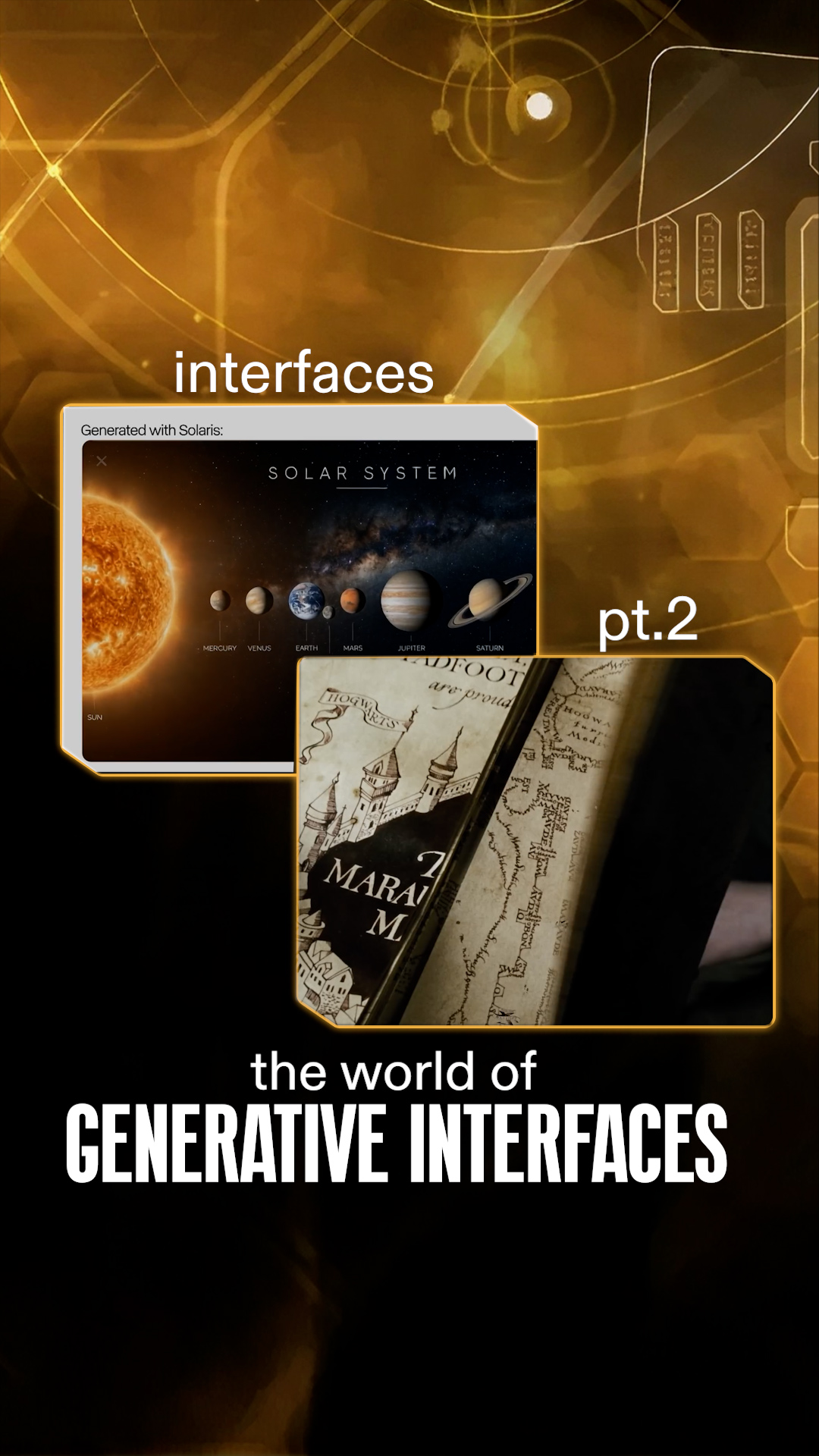
Two weeks ago, Runway, an AI video model company released Solaris, a model in their line of AI systems called Interface World Models.
Solaris is a real-time interactive model that generates the interface itself, frame by frame. Each frame continuously responds to user input.
UIs today are not like this. Terminals, and Graphical UIs in applications dictate what areas you can click on (buttons, drop down menus) etc. And these objects change state based on rigid rules.
Generative interfaces take a different approach. There is no middle code layer that explicitly defines behaviour. According to Runway, this opens up interfaces to do much more.
And so you get demos like this, that are more akin to a game world where you can select and manipulate things. And these interfaces are downstream of WORLD MODELS, which are models that represent a world, and predict how it may change based on interaction. This means that software becomes Alive, and it feels less like navigating through scripted pages and more like interacting with a living environment.
There have been other implementations of this kind of thinking. Common Knowledge, a research lab that just got acqui-hired into Figma, created a product called Flipbook – an infinite visual browser.
As their co-founder said, this is very much like a modern Marauder’s Map.
What do you think? Are World Models really the interface of the future? Or just glacially slow GPU-burning slop?