Apple's Knowledge Navigator
Transcript
An AI butler seamlessly connected to your working life.
This was Apple’s Vision of the Future in 1987.
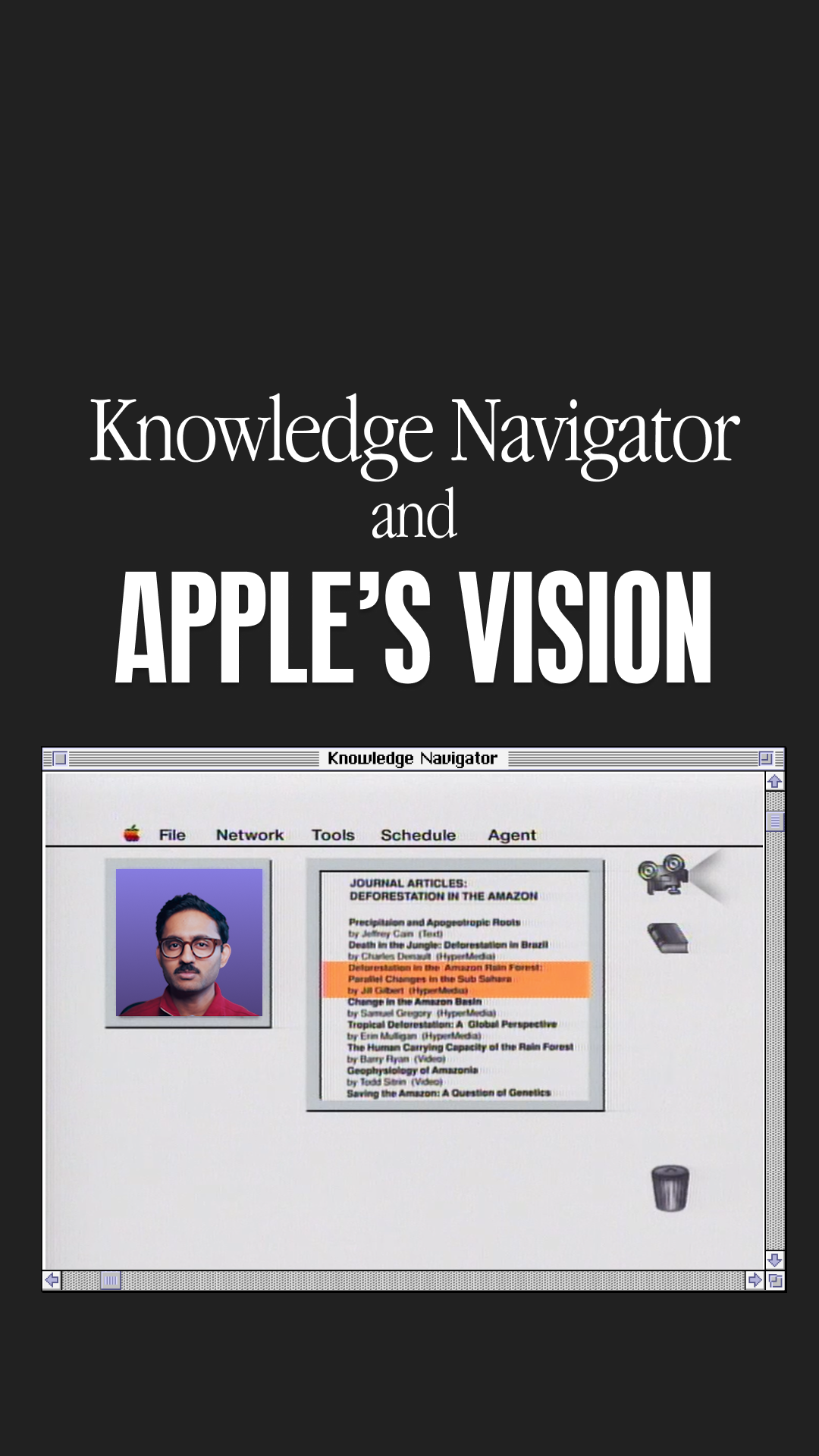
Knowledge Navigator was a concept video put out by Apple as part of then CEO John Sculley’s keynote speech at Educom, a higher education conference for academic computing.
And the demo foresaw many innovations in human-computer interaction.
The device itself was a foldable tablet, it had a conversational AI assistant, seamless video calling, access to personal and global knowledge contexts, and even task delegation!
Apple was in a weird position when they launched this. Steve Jobs had been kicked out two years earlier in 1985, and even though revenues were humming along, there was fear that the company had no long-term vision.
Sculley realized that he was not qualified to be a product visionary – and so along with his mentor Alan Kay, they set about to map out the future that would be obvious to everyone in 20 years.
The earliest version of the Knowledge Navigator ideas were in fact articulated in the epilogue to Sculley’s memoir, where he spoke of this fantasy machine, infused with the soul of intelligent agents.
And three months later as John prepped for Educom, he gave this book to Bud Colligan, Apple’s Director of Higher Education Marketing, and together with Hugh Dubberly, the creative director, they came up with a plan.
Hugh wrote about this experience in Bill Buxton’s book on software design, claiming that the team produced this in 6 weeks, and were inspired by Stewart Brand’s book on the Media Lab, William Gibson’s Neuromancer and even Vernon Vinge’s True Names.
The coolest thing is that this concept demo set the standard for many tech companies’ product line up.
Infoworld did a retrospective on it in 2003, and said that almost everything came true, except natural language in the tech.
And now, even that’s solved.
Which is how you get demos like the one made by Tavus, an AI company specializing in avatars called PALs,
And Clicky, which can do real-time graphics based on user requests.
Now, we’re at the beginning of the next era of human-computer interaction. And I’d love to see today’s tech extrapolated 20 years into the future.
What would that look like?
Notes
I came across Apple's Knowledge Navigator in a talk given by Kwindla Kramer for AI Engineer. You should check it out, it's really nice. Kwindla is very articulate, and he goes over the different eras of tech history. I also found out that he helped set up Oblong Industries with John Underkoffler, whose work I covered in a prior video.