An open-world gem from 1989
Transcript
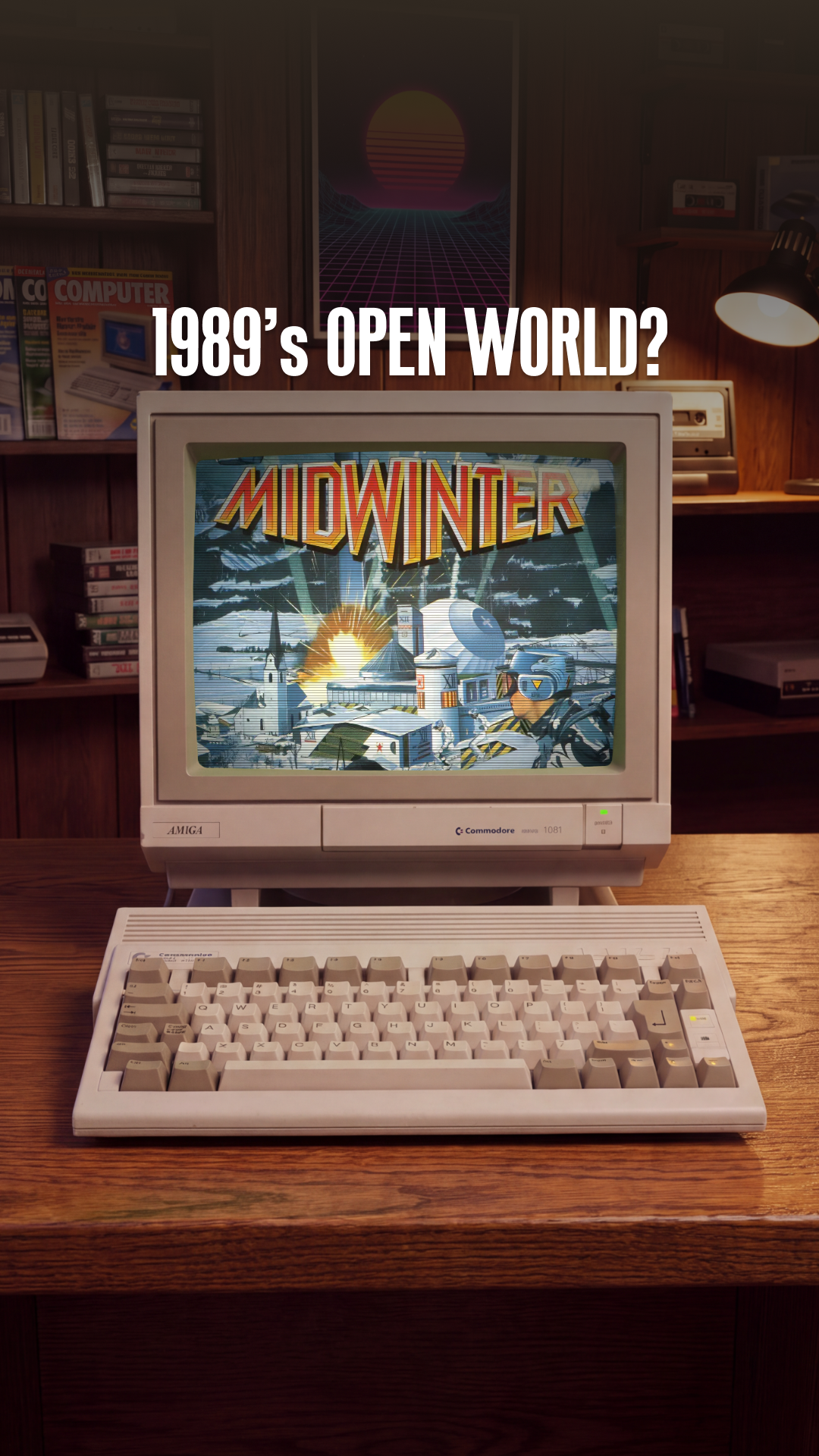
If you want to get good at design or at telling stories, there's an old game from 1989 you should study. It's called Midwinter. At the end of the eighties, a former English teacher named Mike Singleton put you on 160,000 square miles of ice with 32 characters, each with a detailed backstory.
Let's talk about the setting. The game takes place in 2099, after a disaster has covered the whole world in snow and ice, on the Isle of Midwinter. The story is fairly simple. You play as Captain John Stark of the Free Villages Peace Force, and your job is to stop General Masters from taking over the island. As you travel the land, you meet new characters who may or may not agree to help you with your mission.
On the surface, the story seems fairly simple, but the way it was presented made it feel incredibly grand. Remember that this ran on hardware from the eighties. You couldn't really build an open world, so Mike designed a very specific kind of HUD. You traveled only through snow, along the ground, which was very easy to draw. Then you moved from place to place. You could go back into the menu and check the map, and you had three or four ways to get around: you could ski, ride a snowmobile, or hang-glide off cliffs.
As you progressed and met people in different villages, you'd try to talk to them. Depending on your relationship with them and their backstories, you could try to recruit some of them. Some characters could only be recruited by certain other characters, not by the main protagonist, Captain Stark.
One of the more interesting design choices was that the game ran on a two-hour shift. At the end of each shift, you had to give a sitrep, a situation report. Then you could play as a different character and try to keep the mission going from someone else's point of view.
The game gave you a lot of options. What fascinated me as a designer was the UI and the presentation. It felt so intuitive and so interesting, and you saw the whole world through ski goggles. I think it's a fantastic little design experiment from gaming's archives.
It stands out for the depth of the story, because Mike wrote a short novella as the booklet that shipped with the game, where you could learn the backstory, the people, and the setting. It also shows how constraints actually helped tell the story. All of this ran on the Amiga and Atari ST, with the entire interface stuffed into a pair of ski goggles. Mike and his team refused to be limited by the hardware, and that was very cool.
Years later, magazines wrote that playing it felt like time travel, a beacon, a blueprint for how games were going to be.
So if you're looking for a rich artifact, this is one of them. If you've got a copy, try playing it and let me know how it goes.